REVIEW · BANGKOK
Bangkok: Night Bike Tour with Temples & Flower Market Visit
Book on Viator →Operated by Discova Thailand · Bookable on Viator
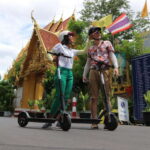
Night biking turns Bangkok into a movie. This 4-hour evening ride strings together temples, big landmarks, and the Pak Khlong Talat flower market when the crowds thin out and the city cools. You’ll cruise on calmer backstreets instead of fighting daytime traffic.
I like how the route hits both old Bangkok and modern sightlines, with ferry views across the Chao Phraya and photo stops that actually make sense. Another thing I really appreciate is the guide factor: people like Woody and Tom are mentioned as friendly, safety-minded, and big on practical context for what you’re seeing.
The main consideration is bike comfort. Some stretches are tight and require confidence in city riding, and humidity can make even a “leisure pace” feel like work, especially if rain pops up.
In This Review
- Key things you’ll notice on this Bangkok night bike tour
- Why Bangkok looks better from two wheels at night
- Price and what $39 buys you in real sightseeing time
- The 6:00 pm meeting, bike fitting, and how the ride is paced
- Stop-by-stop: Loha Prasat to the Democracy Monument backstreets
- Loha Prasat (Wat Ratchanatdaram Woravihara), the Metal Castle
- Riding past Democracy Monument and Khao San back roads
- Rama VIII Bridge, Thammasat University roads, and a sunset ferry over the Chao Phraya
- Rama VIII Bridge photo time
- Through Thammasat University
- Chao Phraya River crossing by ferry at sunset
- Wat Rakang Kositaram and the quiet shift toward the flower market
- Wat Rakang Kositaram (Ayutthaya-era temple)
- Cycling via riverside bike lanes
- Pak Khlong Talat flower market at evening: what to expect and how to use it
- The market stop: Pak Khlong Flower Talat Original
- Grand Palace area, Sanam Luang, and the Giant Swing’s cultural weight
- Pass by the Grand Palace and stop at Sanam Luang views
- Sao Ching Cha (the Giant Swing) stop
- Getting back: old town backstreets and the relaxed ending
- Biking skills, safety, and the guide quality factor
- Clothing, shoes, and weather: the practical stuff that saves your evening
- Who this tour suits best (and who should skip it)
- Should you book this Bangkok night bike tour?
- FAQ
- How long is the Bangkok night bike tour?
- What time does the tour start?
- Where do I meet for the tour?
- How much does it cost?
- How small is the group?
- What’s included in the price?
- What isn’t included?
- Is the tour appropriate for beginners?
- What should I wear for temple visits?
- Does the tour run in rain?
- Can I cancel and get a full refund?
Key things you’ll notice on this Bangkok night bike tour
- Small-group pace (up to 6) keeps the ride from feeling like a cattle move
- Loha Prasat (Metal Castle) gets you off the usual poster stops fast
- Chao Phraya ferry at sunset mixes temples and skyscrapers in one view
- Pak Khlong Talat after dark is when the market is at its most electric for shoppers
- Frequent photo stops and snack breaks make it sightseeing, not just cycling
- Safety gear and guidance are built in, and bikes may include lights for visibility
Why Bangkok looks better from two wheels at night
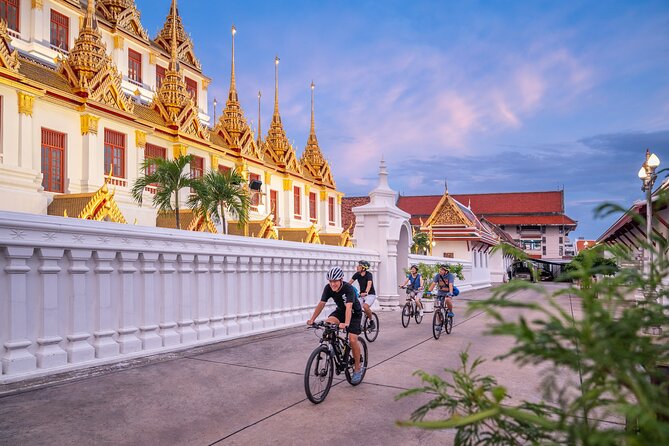
Bangkok at night has a different personality. Daytime is about heat, buses, and intense traffic energy. Evening shifts the mood: air cools, streets loosen up, and the sights feel more human. Cycling is one of the best ways to see that change because you’re moving through the city, not just hopping between it.
This tour is built around a simple idea: you get more landmark variety in less time. You also get the in-between stuff that makes Bangkok feel like Bangkok—side alleys, canal-adjacent lanes, river paths—stuff that you’d miss if you only walk the big tourist corridors.
And yes, you still cover real sights. You’ll roll past major monuments and iconic temple structures, but the bike route keeps you away from the worst daytime bottlenecks. That’s the value: the itinerary isn’t only about famous names. It’s about how you travel between them.
You can also read our reviews of more tours and experiences in Bangkok.
Price and what $39 buys you in real sightseeing time
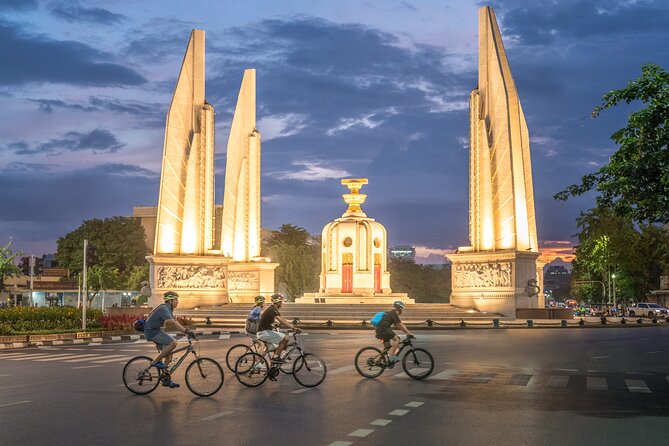
At $39 per person for about 4 hours, the big question is value: what are you actually paying for?
You’re paying for four practical things:
- A real bike setup: a quality mountain bike plus a helmet and a safety briefing.
- A guide who handles the streets: someone who knows how to route you through narrow lanes and landmark clusters.
- Stops that break up the ride: you’re not cycling nonstop for 4 hours.
- Included extras: water refill at the start, plus snacks and light refreshments along the way.
If you tried to copy this on your own, you’d quickly run into two problems: figuring out a safe, efficient route through central Bangkok, and timing the ferry and flower market when they’re best. This tour compresses all of that into one evening without you needing to do map gymnastics.
The trade-off is obvious: it’s not a private ride and it’s not hotel pickup. You’ll meet at a central shop address and you’ll return there. If you’re staying nearby and don’t mind navigating to a meeting point, the price feels fair for the amount of ground you cover.
The 6:00 pm meeting, bike fitting, and how the ride is paced
You gather at 5:30 pm at the Discova Day Tour Shop Bangkok, then the tour leaves at 6:00 pm sharp. Plan extra buffer for traffic getting there. Central Bangkok can move, then stop, then move again, depending on timing and local surges.
The first minutes matter. You’ll get a quick bike fitting and safety briefing, then you’re rolling. After that, the pace stays leisurely with frequent pauses. These stops are not just for stretching. They’re timed for good views, landmark photos, and the kind of on-foot moments that a bike can’t always provide.
A common theme from rider feedback is that the guide makes the difference. People highlighted guides like Woody, Tom, and JoJo as attentive and helpful, with a strong focus on keeping riders safe while still making the ride fun.
Group size is small, and that’s another value point. The tour is described as a small-group experience of up to 6, with an overall cap of 10 on the operator side. Either way, you’re not lost in a crowd of 30 people at busy intersections.
Stop-by-stop: Loha Prasat to the Democracy Monument backstreets
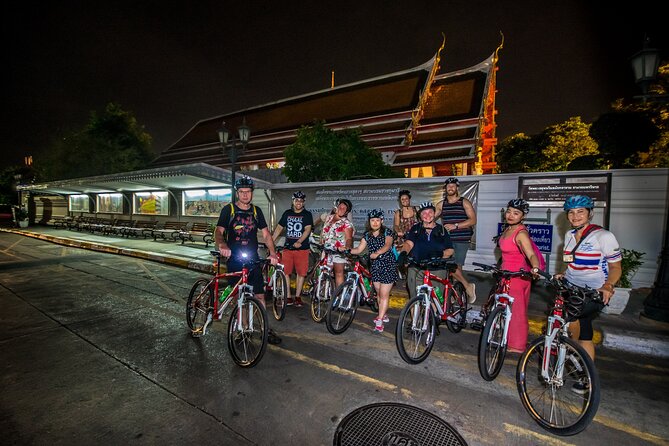
This tour starts with old Bangkok credibility, not just a quick drive-by.
Loha Prasat (Wat Ratchanatdaram Woravihara), the Metal Castle
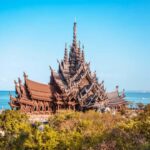
Your first major stop is Loha Prasat, often called the Metal Castle. It’s known for being the first and only metal castle in Thailand. Even if you’re not a hardcore architecture person, it’s the kind of landmark that makes you pause because the details look deliberate, not ornamental-by-accident.
You’ll get time to explore and learn why it matters historically. The best part of bringing this early in the evening is that you’re fresh and focused, before the ride gets more sensory.
Practical note: you’ll want to dress for sacred sites. Shoulders and knees should be covered.

Riding past Democracy Monument and Khao San back roads
After Loha Prasat, the route turns into a Bangkok sampler. You’ll glide past places like the Democracy Monument and move through Khao San Road backstreets rather than only staring at the main drag.
This is where biking shines. Walking would take forever to cover the same cluster efficiently, and driving would cut out the narrow-lane texture that gives Bangkok its personality. On the bike, you feel like you’re traveling with the city, not just watching it.
You’ll also pass landmarks connected to the old town feel, including Phra Athit Fort areas, which helps anchor the later temple and palace views.
Rama VIII Bridge, Thammasat University roads, and a sunset ferry over the Chao Phraya
Rama VIII Bridge photo time
Next you reach Rama VIII Bridge, a favorite spot for photoshoots. The goal here isn’t to rush a checklist; it’s to give you a reason to stop, look, and frame the skyline and river geometry.
This is a good moment if you want photos with depth—street-level movement behind you, and the river line doing the heavy lifting.
Through Thammasat University
You’ll cycle through the area near Thammasat University. It’s a reminder that Bangkok isn’t only temples and monuments. It’s education, everyday life, and neighborhoods that keep functioning long after the sightseeing signs go up.
Chao Phraya River crossing by ferry at sunset
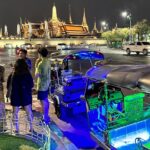
Then comes one of the tour’s biggest visual payoffs: crossing the Chao Phraya by ferry around sunset.
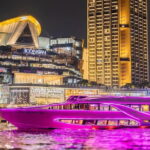
That hour is a sweet spot. The river reflects the sky, the light changes fast, and you see a mix of skyscrapers, temples, and small riverside scenes. The ferry is also a built-in rest. You’re not working your legs while you’re getting a major view.
If you’ve only experienced Bangkok from the road, this ferry moment is the kind of memory that sticks.
Wat Rakang Kositaram and the quiet shift toward the flower market
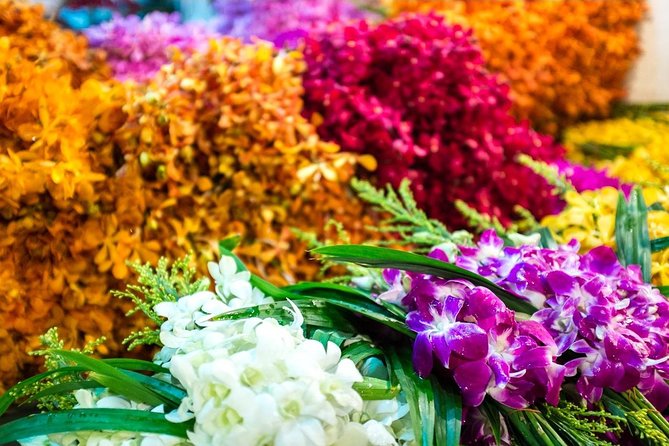
Wat Rakang Kositaram (Ayutthaya-era temple)
You’ll pause at Wat Rakang Kositaram, an older Bangkok temple linked to the Ayutthaya era. It’s a quieter kind of temple stop, more about atmosphere than spectacle.
This stop also works like a reset for your eyes. After bigger monuments and the river crossing, you get something calmer and more traditional before heading to the busiest market segment.
Cycling via riverside bike lanes
From there, the route continues along back roads and then via a riverside bike lane. That matters because it makes the transition to the market smoother. You’re not dropped into a frenzy without context. You arrive in the mood the market creates.
Pak Khlong Talat flower market at evening: what to expect and how to use it
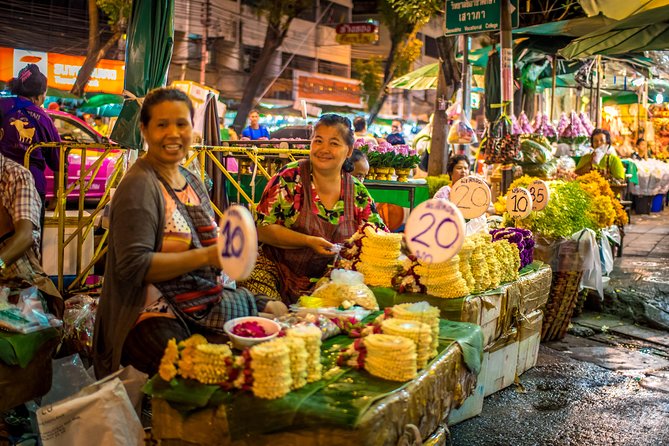
The market stop: Pak Khlong Flower Talat Original
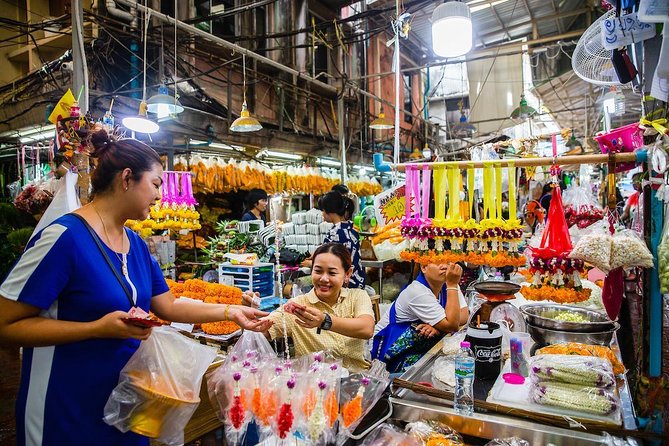
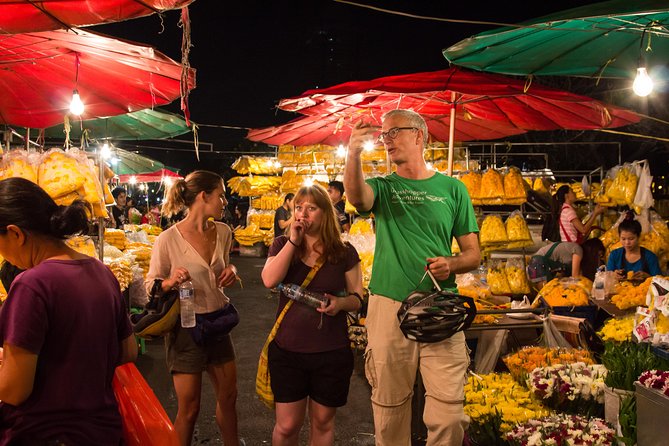
Pak Khlong Talat is the famous Bangkok flower market. It’s known as a wholesale market and it runs 24 hours, but it’s busiest in the evening when locals shop for flowers and produce.
This stop is one of the most praised parts of the tour. People consistently call out the market as a highlight, and that’s easy to understand. You don’t just see flowers. You see how people buy and bundle them, how stalls work, and how the market breathes.
You’ll have time to walk around. There’s also street food in the mix, and several riders mention enjoying what the guide suggests. The food break is light but fun—think of it as a way to make your evening feel complete rather than just scenic.
A practical tip: wear comfortable shoes. Even though it’s only a stop, markets are not smooth-floor environments. Plan for stairs, uneven ground, and lots of standing.
Grand Palace area, Sanam Luang, and the Giant Swing’s cultural weight
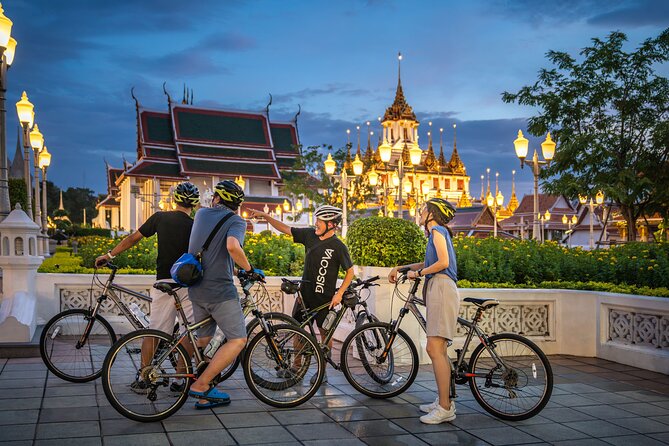
Pass by the Grand Palace and stop at Sanam Luang views
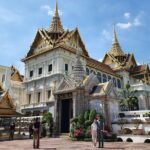
As you keep cycling, you pass the Grand Palace area and arrive near Sanam Luang. The point here is the view angle: you can see sparkling chedis associated with the palace complex.
This is another “photo you’ll actually use later” moment. If you only look at the Grand Palace from the main tourist approach, you miss how it looks from different edges. The bike route offers those edges.
Sao Ching Cha (the Giant Swing) stop
Your final big landmark stop is Sao Ching Cha, also known locally as the Giant Swing. This is one of those structures that makes your brain go quiet for a second because it’s so tall and so visually bold.
You’ll get time to take photos and learn about its cultural and historical significance. The stop duration isn’t long, but it’s enough to understand why locals recognize it instantly.
Getting back: old town backstreets and the relaxed ending
After the Giant Swing, you pedal through backstreets in the historic old town area and cycle back to the starting meeting point in central Bangkok. The ride ends where it began, so you’re not scrambling for transportation afterward.
Expect the ending to feel smoother than the middle. You’re past the biggest crossings and the market intensity. By now, you’re in the home stretch mode: more conversation, more photos if you want them, and more “okay, we’re really seeing Bangkok like this” energy.
Biking skills, safety, and the guide quality factor
This tour is designed for most people who are comfortable riding in a city and have a reasonable fitness level. It’s not a mountain climb. But you do need basic bike confidence.
Narrow lanes are part of the deal. Some stretches can feel tricky if you’re not used to riding near walls, parked bikes, scooters, or close-quarters turns. One rider feedback even called out that navigation can be more challenging than on some city-bike tours. That’s not a reason to avoid it. It’s a reason to be honest about your comfort level before you show up.
Safety is a core part of the experience. Guides are described as attentive and focused on safe movement through traffic zones and backstreets. One rider also mentioned lights mounted on the bike, which is useful for evening visibility.
Important balance note: there’s also an outlier negative story where someone reported an injury and blamed guide incompetence. I can’t ignore that. For you, the takeaway is simple: follow the guide’s instructions tightly, keep your speed controlled, and speak up immediately if anything feels unsafe.
Clothing, shoes, and weather: the practical stuff that saves your evening
This tour runs in all weather conditions. Dress for heat plus the fact that night rides still come with humidity. If rain shows up, you’ll likely still be on the bike, just with a different vibe.
You should wear comfortable clothing and closed-toed shoes. For temple and pagoda visits, bring clothing that covers shoulders and knees. If you don’t have it with you, you may need to improvise fast, and it’s better to plan ahead.
Bring basic patience too. Even with an organized route, Bangkok is Bangkok. The ride is a small adventure, not a museum line.
Who this tour suits best (and who should skip it)
This night bike tour is a great match if you want:
- a faster way to see central Bangkok landmarks than walking alone
- a mix of temples + river views + market energy
- a route that leans into side streets and local rhythm
It’s also a good choice for people who enjoy the contrast of old and new Bangkok—metal castle details, river ferries, and modern skyline angles in the same evening.
You might want to skip it if:
- you’re not comfortable riding in a city environment
- you hate tight turns and narrow lanes
- you’re looking for a fully relaxed sightseeing day with zero physical effort
If you’re an experienced cyclist, you may find it straightforward and fun. If you’re a first-timer, treat it like a skills-and-safety exercise and stick close to the guide.
Should you book this Bangkok night bike tour?
I’d book it if you want an evening that feels like Bangkok in motion, not Bangkok on rails. The combination of Loha Prasat, a Chao Phraya sunset ferry, and Pak Khlong Talat is a strong lineup, and the market stop is repeatedly treated as the highlight for a reason. Add in a small-group feel, included water and snacks, and guides who show up prepared, and the $39 price starts to look like a bargain.
I wouldn’t book it on blind hope if bike handling in tight city spaces makes you nervous. Your comfort matters here. If you show up ready—covered clothing for temples, closed-toe shoes, realistic expectations for humidity and street cycling—this tour can give you a very different angle on Bangkok fast.
FAQ
How long is the Bangkok night bike tour?
It’s about 4 hours.
What time does the tour start?
The tour departs at 6:00 pm, with meeting at 5:30 pm.
Where do I meet for the tour?
You’ll meet at 719 Maha Chai Rd, Khwaeng Wang Burapha Phirom, Khet Phra Nakhon, Krung Thep Maha Nakhon 10200, Thailand.
How much does it cost?
The price is $39.00 per person.
How small is the group?
The tour is described as a small-group experience with a maximum of 6 guests, and there is also a stated maximum of 10 travelers.
What’s included in the price?
Included are a high-quality mountain bike and helmet, a licensed English-speaking bike guide, drinking water refill at the starting point, small group experience, tasty local snacks along the route, and accidental insurance coverage.
What isn’t included?
Hotel pickup and drop-off are not included.
Is the tour appropriate for beginners?
Most people can participate, but it is suitable for those who are comfortable riding a bike in the city and have a reasonable level of fitness.
What should I wear for temple visits?
For sacred sites, temples, and pagodas, you’ll need clothing that covers your shoulders and knees. Closed-toed shoes are also required.
Does the tour run in rain?
Yes, it operates in all weather conditions, so you should dress appropriately.
Can I cancel and get a full refund?
You can cancel up to 24 hours in advance for a full refund. If you cancel within 24 hours of the experience start time, the amount paid is not refunded.